

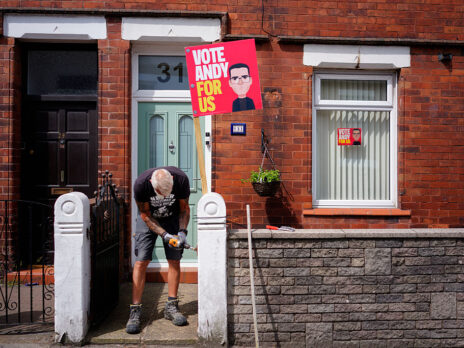
Darlington Street is a long road of redbrick terraces leading into Wigan town centre. These houses, built in the classic pavement-fronted style for mill workers and miners across industrial England, can be found in many other northern towns. But this particular stretch of two-up-two-downs seems uniquely fated to be a symbol of Britain’s woes.
When George Orwell was working on The Road to Wigan Pier in 1936, he lodged at a tripe shop riddled with beetles on this street. He had asked a local to point him towards the worst place to stay. On the same quest today, he would have had plenty of suggestions. Darlington Street and its offshoots are thought around town to have Britain’s highest concentration of Serco-run and other “HMOs”. HMOs are houses in multiple occupation, and Serco is one of the private outsourcing companies with a government contract to rent them out to asylum seekers.
Asylum seekers and their neighbours alike complain about these properties. The former struggle with their poor maintenance and sometimes sorry state. The latter may, in the same breath, say they are a luxury afforded to asylum seekers and that they affect the character of their street.
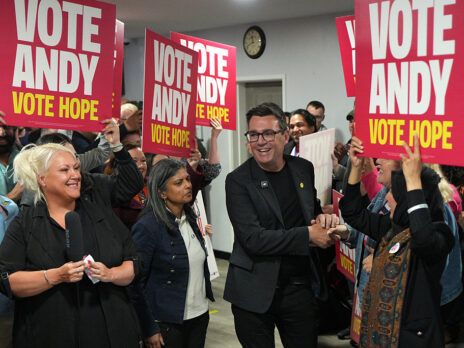
They are commandeered in parts of Britain where housing is cheapest – the towns and villages of Wigan and Makerfield being a hotspot. Again, this corner of the north-west is becoming a symbol. Not just for Orwell’s toiling working-class, or for the toxicity of asylum, but for Britain’s political future. In the Makerfield by-election on 18 June, voters will decide whether Andy Burnham can challenge Keir Starmer to become prime minister and give Labour a second chance at government, or demonstrate that no one now can stop the march of Nigel Farage on Downing Street.

The north-west town’s MP, Lisa Nandy, the Culture Secretary, told me when she goes door-knocking, “you’re often on a road where every other house has been taken up as an HMO” – for asylum seekers, as well as for other housing schemes for ex-offenders, drug addicts and the homeless. “Because the properties are cheaper, they all target the same areas,” she says, which drives up rents. Her constituents tell her they now feel part of “a very transient community”, where they don’t know their neighbours, new people keep arriving, “and a lot of social problems [are] concentrated in one area”. Changing properties into HMOs “essentially quadruples” the number of residents, and this can lead to rubbish piling up and no space to park.
Serco leases houses from private landlords and runs them on their behalf. I have heard from landlords who are being paid between £1,000 and £2,000 a month in rent on these properties, depending on the number of bedrooms, location and condition. The money these landlords are receiving comes from the Home Office, which agreed ten-year contracts to outsource the accommodation of asylum seekers in hotels and houses to Serco and two other firms: Clearsprings and Mears. These contracts are projected to have cost the taxpayer a total of £15.3bn by 2029.
There are 93,653 asylum seekers housed in Home Office asylum accommodation in the UK, around 22 per cent of whom are in hotels, some of which Serco also runs. The hotels cost around £170 a night per person, compared with £14 per night on average in an HMO. The government has prioritised closing hotels, which are not only costly but also lightning rods for social unrest. As a result, the number of people being quietly dispersed to houses is rising every year – there are now 68,719 in tens of thousands of houses across the country. But this number will keep growing, as more asylum seekers keep coming; 43,806 people arrived by illegal routes in the year ending March 2026.
A Home Office spokesperson told the New Statesman: “We will close every single asylum hotel, moving illegal migrants into basic accommodation like military barracks. We have already reduced the number of asylum seekers in asylum hotels by 35 per cent in the past year, and overall asylum support costs by 15 per cent in the last financial year.”
HMO Britain is snowballing from a tale of certain postcodes into a national story. Last year brought 82,100 applications for asylum in the UK – slightly lower than in 2024, but still the third highest total on record. The world is unstable, on the move, and the British state is an unfit host: failing to build homes at a rate fast enough for its citizens, let alone the newcomers desperate to reach its shores.
Meanwhile, landlords of Serco properties I’ve spoken to have described the contracts as a dream ticket; one with HMOs in Norfolk called the company “the fairy godmother”. They are paid guaranteed rent and maintenance costs with “none of the aggro” and “none of the bureaucracy” that an ordinary let brings, according to another with 30 Serco-run properties across the north-west.
A typical Serco HMO contract I had sight of offers a seven-year lease with a one-year break clause, and includes “monthly property inspections”, “council tax and utilities paid”, “no call-out payments to contractors”, no management, legal, registration or set-up fees, and “day-to-day maintenance and repairs undertaken at no cost to the landlord”. The landlord is responsible for structural repairs and fundamentals such as pipework.
Some property investors are buying up cheap properties, contracting them with Serco then advertising them to cash buyers as attractive investments with guaranteed steady rent. They are promising as high as 10.5 per cent returns on cheap houses selling for as little as £148,600, according to a spreadsheet I’ve seen made by one of these investors – calculating profits on a list of properties around the north-west that began their Serco tenancies in 2024.
Landlords have also added to the perception of migrants being prioritised for housing by kicking out existing tenants (before no-fault evictions were recently banned) in order to rent to Serco instead. “Sure, this deprives the general tenant population from rental supply,” one told me. “But why wouldn’t you choose the simplest deal?” Serco’s HMO offer is tempting enough for landlords to overlook local backlash. “Asylum seekers in this accommodation are some of the best occupiers you can be next door to,” said one. “Which other occupier is policed as strictly as these? It’s difficult to provide a cogent objection on the basis of just emotion.”
Yet emotion runs high. The UK’s asylum accommodation model has led to rioting and protests for two consecutive summers across Britain. Protesters direct their rage at the government, the council, police and asylum seekers. But occasionally, you see signs reading “Serco Out”. I’ve even seen a Serco employee in Serco uniform turn up to one anti-asylum hotel protest. Posts in local Facebook groups, particularly where a lot of Serco’s housing is concentrated, in the north-west, identify and bemoan new HMOs. “[We’re the] poorest third world Serco cesspit part of Wigan now,” as one post puts it in a neighbourhood group situated near Darlington Street.
Reform UK’s home affairs spokesperson, Zia Yusuf, has accused landlords accepting “a golden Serco contract” of “betraying your country”. Public resentment over people crossing the Channel on small boats has combined with angst about housing. This situation has become a constant national talking point – particularly on Britain’s new right. Immigration now often tops polls of the issues that matter most to voters.
Asylum is particularly pertinent to the campaign ahead of the Makerfield by-election. The constituency overlaps with Wigan council, on which Reform took all but one seat during the local elections in May. Burnham told the New Statesman in an interview last September that he wanted to end the “atrocious” and “dangerous” system in which asylum seekers are settled around the country, and to make life “doable” for those trapped in our precarious outsourced economy, via greater public control. During the Makerfield campaign he has gone further, writing that “outsourced contracts that seek the cheapest accommodation in some of the UK’s most deprived communities is not the basis for a fair asylum system” – a “dysfunctional” part of Whitehall that needs fixing. He has been using the phrase “the unaccountable state”, but has also since said he would only seek to “reform” the Home Office contracts.
Farage, leader of Reform – Labour’s main challenger in the area – has taken to nicknaming Burnham “Open Borders Burnham” and posted a seemingly AI-generated image on X of migrants crossing the Channel holding up pro-Burnham campaign signs. “Are you getting desperate, lad?” Burnham replied. One poll of the constituency has put support for Restore, a far-right party led by the ex-Reform MP Rupert Lowe that endorses “remigration” (seen by critics as a euphemism for ethnic cleansing), at 7 per cent.
But whether it is Nigel Farage or Andy Burnham or someone else who ends up next in No 10, the truth is that they will face the exact same dilemma. The state has neither the capacity nor the political capital to build, buy or rent out specific asylum housing itself, and nor do councils.
“The government is the government,” one Serco senior employee put it to me, whichever party is in power. “It can break the contract whenever it likes, and we can just go ‘OK’. But it would never do that because it would be a disaster – there’s nowhere else to put them [asylum seekers].”
This isn’t corporate bravado: according to insiders with knowledge of the policy, the Home Office has been a “basket case” that “doesn’t know what to do” about the failing asylum accommodation system and “isn’t doing anything about it”, despite constant focus on closing the hotels.
It’s asylum Hotel California: we can check out any time we like, but we can never leave. And it’s not just the asylum system that is stuck. In almost every contentious policy area, we are trapped in the Serco state.
When Serco property-sourcing officers try to woo potential landlords, they paint a picture of prestige, promising a “seven-year lease with an FTSE 250 company” and “blue chip tenants”, in one email I’ve seen (Serco is the tenant, and the asylum seekers are “service users”).
Serco (a portmanteau of “Services Company”) is a publicly listed company, and one of the biggest private providers of public services in the world, with 47,663 staff worldwide. Its main customer is the UK, accounting for 35 per cent of its business. It has no majority shareholder; Serco’s top 25 shareholders own more than 69 per cent of the company, with asset management giants BlackRock and JP Morgan top. Its overall revenue last financial year was £4.9bn, turning a £272m profit.
It started life in 1919 in the US as the Radio Corporation of America, doing wireless communications for the US army, and developing the technology that turned silent films into “talkies”. By 1929, a team of its engineers had travelled to England and set up a studio – bringing its innovation to Elstree Film Studios and a cinema at Madame Tussauds. When the Second World War broke out, it began developing top-secret production equipment for the UK War Department intended to simulate battle noise to confuse the enemy – a project backed by Winston Churchill, whose grandson Rupert Soames would end up serving as CEO of Serco from 2014 to 2022. This was how it became a defence contractor, winning the Cold War-era contract to instal the top-secret “four-minute warning” radar station in case of Soviet nuclear attack. It still operates and maintains the eerie concrete monolith of RAF Fylingdales in north Yorkshire today.
Initially the armed forces were sceptical of allowing a private contractor inside the UK’s military bases, and it took Margaret Thatcher to make outsourcing not only the norm, but preferable. By the end of her first term, as a now out of print 2002 book Serco: The Family History recalls, the company “did not need to confine its aspirations for expansion” to defence. There was a realisation that “improvements in efficiency could be achieved by contracting out”. As they won contracts everywhere from British Aerospace to local government, “every excuse was taken to have a celebration”, with “happy hours” almost every day at lunch.
The legacy is our outsourced state. Serco-administered e-Borders manage entrance into Britain; Serco-managed speed cameras oversee Britain’s roads, where you can drive past leisure centres, prisons and libraries all delivered by Serco; Serco-run bin lorries and Serco-contracted pest control try to keep Britain clean; Serco monitors for nuclear attack on the Yorkshire Moors. It takes us from the cradle to the grave: a Serco NHS hospital catering worker probably served your mother tea and toast after you were born, and a care home place processed by Serco may make you as comfortable as possible in your last weeks of life.
Thatcher is often accused of “selling off the family silver” when she privatised public utilities and state-controlled industries. But less attention is paid to the services she pawned off, now in the hands of outsourcing giants.
The government has long claimed it will end the use of hotels to house asylum seekers by 2029, when the contract with Serco and other private firms ends. But this is a false deadline. There is a break clause in the overall contract this year that still hasn’t been triggered. In any case, the individual hotel leases are signed on a rolling basis and can be exited when needed. In fact, even as ministers boasted that they were closing hotels, contracts were still being signed. “Government is managing the truth somewhat,” as a contact in the contracting process put it to me last year. “It’s signing new hotel contracts every day but saying it’s closing them down.”
I’m told the government has privately been making desperate requests to Serco – for example, asking if it could switch to using bigger hotels – possibly to make the headline number of hotels fall. Alternative solutions to the hotel problem include the use of military barracks, though these too have drawn protests. There are also big blocks of unused student accommodation, but because they are concentrated in town and city centres and therefore highly visible to the public, the mostly Labour MPs representing these constituencies push back.
Another idea being considered by the government is to bring asylum accommodation, which has been outsourced to private firms since 2012, under council control. But this is not the panacea some politicians believe it to be: when the government privately mooted a number of pilots giving power – and central government funding – to councils to do this, few said they would participate. The Home Office was surprised by the stark lack of take-up. But no one wants protests, or to take the blame. Waiting lists for a council house across the country are long. A state that could once guarantee a safe and affordable place for its citizens to live no longer can. This reality has allowed a resentful, zero-sum grievance to take root over decades: the perception that migrants are prioritised for council houses. If councils en masse directly took on the duty to house newcomers, while so many Brits go without, this could inflame these tensions.
It’s also no way out of the housing shortage, with councils already stuck leaving residents on long council house waiting lists, and scrabbling around for temporary accommodation to fulfil their legal duty to house homeless people – a task made harder by Home Office contractors taking up HMOs. State weakness is both a symptom and cause of Serco Britain.
Rupert Soames, who was CEO of Serco for eight years, told me government officials once war-gamed Serco’s potential bankruptcy – so catastrophic it would have been for the British state. In 2013, before Soames took over, the Serious Fraud Office launched an investigation into Serco over a multimillion-pound fraud and false accounting, overcharging to tag criminals who didn’t exist. Serco was fined £19.2m but bosses were eventually cleared of fraud. Despite being fined and having contracts ended for poor performance over the years, Serco is so integral to the British state that Margaret Hodge, a Labour politician who led an investigation into Serco, has called it “too big to fail”, because “there are too many services that would collapse” if it went bankrupt. It simply runs too many state functions for it to be feasible to allow it to go bust.
It’s not just Serco. So much of the state, from welfare, prisons and asylum to the NHS, security and social care, is in the hands of gnomically named companies most voters have never heard of: Capita, Sodexo, G4S. But if these are the undercurrents eroding the British state, then a tsunami is about to engulf it. Palantir, the data services giant, and Oracle, one of the world’s largest tech multinationals, compete to make the cloud services, data platforms, and security and intelligence infrastructure of Britain the business of some of the richest and most politically influential men in the US.
If Serco is a symptom of Britain’s chronic inability to build more housing, or manage its borders, then these tech hegemons are a sign of something more profound. Look at Britain’s future, and there is the dark silhouette of the shadow state. It cannot build what it needs to keep up with the new industrial revolution already under way. The AI-enabled cloud services and software platforms we need – our digital souls – are already falling into the hands of anonymous investors.
Palantir has a £330m deal with NHS England, a £240.6m deal with the Ministry of Defence, and others with the Financial Conduct Authority and numerous English police forces. A parliamentary select committee has warned that its UK government contracts put citizens’ data at risk, and the London mayor, Sadiq Khan, as well as a number of NHS staff have pushed against its creep into public services. (Palantir has said it was appointed “in line with public contract regulations” and all data remains under the NHS’s control.)
Palantir’s customers include Donald Trump’s anti-migrant state militia, Immigration and Customs Enforcement (Ice), and the Israeli military. It was co-founded by the controversial libertarian billionaire Peter Thiel, and is run by a CEO who has criticised the “hollow pluralism” of the West. Serco, often referred to as the most influential company no one’s heard of, has recently appointed Fiona Walters as CEO of its UK and Europe division. She joins from the private security giant G4S, which has contracts with Ice.
When in opposition during the pandemic, Labour called on Boris Johnson’s government to “sack Serco” following its involvement in the notoriously expensive contact-tracing programme that had an underwhelming impact on Covid’s spread. The party’s then deputy leader, Angela Rayner, promised the “biggest wave of insourcing back into our public services for a generation”.
There is little evidence of this in the Cabinet Office, which oversees public procurement policy. One official there with experience of the department under the Tories reflected to me that not much had changed with Labour’s arrival – that Keir Starmer’s approach to the machinery of government was much the same as Rishi Sunak’s had been. “Capita, Serco, G4S, there’s so many of them I get them mixed up,” said a senior official at the prisons service with knowledge of Ministry of Justice Serco contracts. “We haven’t seen much evidence of that [insourcing] yet,” said Nick Davies, a public services expert at the Institute for Government, a Whitehall-watching think tank.
A government spokesperson told the New Statesman: “With a new public interest test and insourcing strategies for every government department, we will make the biggest wave of insourcing in a generation a reality.”
The question is whether a potential future prime minister, such as Andy Burnham, could overthrow the outsourced state. In Makerfield, Labour campaigners have noticed certain streets filled with house shares, whether managed by Serco for asylum seekers or the probation service for prison leavers. They can tell which are HMOs – from the lockboxes, yes, but often also the unkempt gardens, overfilled bins and boarded-up windows. There are four or five HMO “hotspots” in Makerfield, which correlate with its poorest neighbourhoods.
Everyone I speak to around Wigan knows the HMO acronym. There are anecdotes of vandalism and fights and arrests, claims that some residents no longer feel safe, and sometimes out-and-out racism from local Brits. Occasionally, an HMO will have its windows smashed or paint thrown over it, but they don’t attract as much attention as the hotels. Mostly, the conversations I have are of a different kind than those I’ve had with protesters outside asylum hotels; there, the language of the far right can dominate. These are quietly houseproud locals – rooted in their area, sympathetic to neighbours in difficulty – who are nevertheless ground down day after day by having policies foisted on them that they cannot control. Outside the hotels there is window-smashing rage; on HMO streets you find curtain-closing dismay.
One lifelong resident complains that her next-door neighbour, a tradesman, reassured her that he would be renting out his house to “four professionals” and took a Serco contract instead. “He’s in a fancy house now, living off suffering, his attitude is: ‘I don’t care, as long as I’m making money.’ I’d love to see the car he drives.” Although she gets along with the two Kurdish men currently living next door, she hasn’t always had such a good experience – claiming that the three-bed house had previously been occupied by what seemed like seven men, with four mattresses in one room, and was noisy in the early hours with music, chatting and prayer.
“A lot of houses are going up for private rent, and all of a sudden you have Syrians and other people from warzones moving in; they move them in at midnight when there’s no one around, but I’ve seen it on someone’s Ring doorbell,” claims a man who lives locally. “This street was so quiet but now the population is always changing; you’re always waiting for more to move in and out.”
I’m told that when there is a problem – noise complaints or overflowing bins because of overcrowding, say – there’s “no chance” of getting in touch with Serco. “They don’t have 99 per cent of an idea of what goes on in these houses,” the man I speak to says. “They’re supposed to keep an eye on them but they’re never here.” A spokesperson for Serco told the New Statesman that their housing officers inspect properties monthly and that they take all complaints they receive seriously.
I wander up one side of the street and then back down the other. On this street, there are three Serco addresses: one houses a family seeking asylum, another a group of male asylum seekers, and another female asylum seekers – all awaiting decisions on their claims. The asylum appeals backlog has doubled in almost a year, to 63 weeks.
Elsewhere in the borough, on a street I won’t name, I’m warmly welcomed into a Serco house. It is a typical four-bed terrace. Four women live here: half the Serco HMOs in Wigan are occupied by groups of solo women, or families. It is a lively house; they giggle at their nickname for the Vietnamese resident, a woman in her thirties who was trafficked to the UK – “Smalley” (“she’s so small she doesn’t need the biggest room!”). A pregnant 25-year-old Eritrean woman, Sojat, busies herself in the galley kitchen, cooking me a meal of chicken, rice and sweetly spiced himbasha bread – despite my repeated protestations. She had to flee political repression in Eritrea two years ago. She didn’t choose the UK: her mother paid a smuggler to help her escape, and she was put on a plane to Britain.
I am given a tour. Upstairs, there are three pokey bedrooms with individual padlocks on each door, filled with suitcases and flatpack cupboards beside the single beds. There is one more bedroom downstairs and, as is apparently uncommon for HMO like these, a living room – a gloomy space lit by a bare light bulb that illuminates the Sixties ceiling of textured Artex swirl. The only decorations are a no-smoking sign, a white A4 sheet blue-tacked on to the wall asking residents to “please keep kitchen tidy” (it is), and a plastic Christmas tree with wilting tinsel in the corner. The carpet is a worn municipal grey, and a brown leatherette sofa with a broken leg is held up by an empty soup can.
All the women I meet go to weekly English lessons held by a local charity called Support for Wigan Arrivals Project. They are aware of public hostility, and harsher government policies coming in, describing the feeling of “panic” this can cause for people who have tried to escape “dangerous situations and war, places we cannot stay”. Their neighbours, who have a big Union Jack in the window, are friendly and check in on them regularly, though. The women live off the standard Home Office support of £49.18 a week (it’s just £9.95 a week for hotel residents), topped up on their government-issued “Aspen” (Asylum Support Enablement) cards. Sometimes they don’t receive the money: one spent three days without food. Their living conditions are basic. There’s a half-sized fridge, washing machines aren’t supplied as standard, and they say their toilet was broken for over a year before Serco fixed it – they had to carry buckets of water up and down the stairs to fill the cistern and empty it manually as it wouldn’t flush, they tell me.
There were nearly 5,000 complaints against asylum contractors escalated to the Home Office in 2022 to 2025, including payment issues, “property suitability”, food not meeting the legal standards, and staff behaviour towards asylum seekers, according to documents I obtained via a Freedom of Information request. Serco featured in 1,816 of the 4,962 complaints escalated, surpassed only by Clearsprings’ 1,975.
Reporting on anti-migrant protests, I’ve been told that “illegal immigrants are living in luxury hotels” and “nice houses”. Sources within Serco paint a different picture. A former Serco hotel worker at the Metropole Hotel in Blackpool blew the whistle to online publication the Lead last year on “terrible” conditions at the hotel, including collapsing ceilings and raw sewage leaks. A senior Serco employee is blunt, claiming: “The hotels are horrible, the idea that they’re living in luxury is so wrong – but that’s what the government wants, they don’t want to pay us to make them nicer.” One figure I spoke to who has visited 20 to 30 Serco properties in Wigan rejected the myth of newcomers being handed lovely newly refurbished properties. “Sorry to be boring, but they’re completely mundane, and I’ve seen some in a shocking state.” A spokesperson for Serco told the New Statesman they “categorically reject these allegations”. Of HMOs, they added: “All our rental properties meet mandatory council and Home Office standards, ensuring they are safe and fit to live in”, and “any suggestion that a hotel is not being managed correctly by Serco is simply not true”.
A spokesperson for the Home Office said: “We will accept nothing but the highest standards from accommodation providers, ensuring safety and welfare provisions for those receiving support.”
Over the course of reporting this piece, I have heard the stories of many people experiencing Serco services first-hand – asylum seekers, immigration detainees, people wearing GPS ankle tags when on immigration bail (when you live in the community while the Home Office decides your status). Hana, an Albanian airport worker who was tricked by a gang into slave labour on a cannabis farm in England, says she was made by Serco to feel “like I was the criminal” when detained. Mariam, now a campaigner at the nonprofit After Exploitation, said her own experience of being detained as a trafficking victim (while her captors walked free) has given her “lasting trauma” – feeling haunted when she hears keys jangle, and when she sees a Serco escort van in public. A Serco spokesperson told the New Statesman it has the “highest standards” for its staff and services, and that “the safety of our staff and service users is our number one priority”. It added: “The decision on who is detained is a matter for the Home Office.”
Serco operates three out of seven “immigration removal centres” in the UK, and also has a contract to tag migrants and asylum seekers in the community. Government guidance states vulnerable people should only be detained in “exceptional circumstances”, but a growing number of people who have been tortured or trafficked are falling into this system and the UN has criticised the practice.
Even the wider public, with no experience of the asylum system, will have noticed the shortcomings of the Serco state. Many of Britain’s most toxic and tabloid-worthy issues involve Serco’s name in some way. Early-release prisoners who went missing or broke their probation conditions? Serco was supposed to be electronically tagging them. A welfare system that neither provides a safety net nor a trampoline back into work? Serco does the work capability and disability benefit assessments. Even when the deployment of HMS Dragon to respond to Iranian bombing was delayed, shipyard workers blamed Serco management of in-port services (a claim Serco denies).
The company was once a byword for coalition-era cost-cutting (a description Serco disputes) – cropping up everywhere in the 2010s from crumbling prisons and courts to the dangerously fragmented probation service to failing out-of-hours GP practices. (Serco rejects this characterisation of its services.) It also became synonymous with a cruel and faceless bureaucracy, from the once notorious work capability assessments for the Department for Work and Pensions to scandals involving mainly women and children at the Yarl’s Wood detention centre that it has run since 2007. But with the high-profile toxicity of anti-asylum politics, Serco has moved from being a villain of the left to also being one of the right. Or, as one senior employee put it to me: “Everyone hates us now.”
In a statement, Fiona Walters, CEO of Serco UK & Europe, told the New Statesman the company “strongly dispute[s]” the claims made in this piece, “which fundamentally mischaracterise our business, our work and values. Serco provides critical services to the UK government and we have a track record of efficient and effective delivery, contributing to safer societies for the communities we serve, and value for taxpayers.
“Serco is unrecognisable from the company it was over a decade ago. Our contracts operate within strict performance, ethical and governance frameworks, under comprehensive scrutiny from the government and multiple regulators. We take our obligations very seriously and are committed to the highest operational standards.”
The shadow state is way for the government to outsource blame for poor policymaking and short-sighted penny-pinching. In fact, someone who was until recently senior at Serco recalled something of a gentleman’s agreement between ministers and Serco bosses. “When something went wrong, you’d go into the department for a nice coffee and a chat, and then the minister afterwards would say on the news that they’d hauled you in and given you a telling off.” Both Serco and the Home Office strongly reject this characterisation.
When outsourcing contracts, government officials are often tempted by the lowest-priced bids. Once a supplier is chosen, there can be cases of “lock in” – when a firm can effectively set the terms of future contracts because it is so huge and embedded in the state that no one else can be considered to do the job. A wild example of this was that after the scandal of Serco and G4S overcharging to tag non-existent prisoners in 2013, the supplier that stepped in – Capita – subcontracted the tagging to… G4S, as the journalist Alan White writes in his 2017 book Who Really Runs Britain?
Despite policies causing misery and waste, private firms keep winning contracts and politicians keep the blame at arm’s length. No minister had to resign over the 2013 scandal. When G4S failed to recruit enough security guards for the London 2012 Olympic Games, the military stepped in last-minute to save everyone’s blushes.
During a second consecutive summer of rioting and protesting outside asylum hotels last year, the subject of far-right pressure was discussed by the company’s most senior figures at a private meeting on 13 August at a Serco office in Victoria, London – an ark-like hulk of glass. The group chief executive, Anthony Kirby, the then interim UK and Europe CEO (now CFO), Helen Shaw, and the prisons and immigration director, Claudia Sturt, were present, addressing concerns of six members of the progressive shareholder group Shareholders Show Up, who asked about Serco’s human rights obligations when it came to GPS tagging migrants.
In a cordial meeting over biscuits and cups of tea and coffee, I was told, the Serco bosses said they faced a lot of pressure from the far right around reducing the taxpayer cost of accommodating asylum seekers. They claimed the company did have a moral framework and drew red lines where a government policy didn’t align with its values. An example they gave was of the Home Office asking them to increase the occupancy rate of hotels to accommodate “three people per room” even if they were strangers, and said the company pushed back against the idea.
Less than a year later, on 22 April of this year, the pressure built again at the company’s AGM. The company board and 20 or so shareholders, dressed in the various uniforms of planet finance (athleisure, baseball caps and cardigans, suits), arrived in the airy, heel-clacking lobby of the 10 Upper Bank Street high-rise in Canary Wharf.
As they waited beside coffee machines and trays of cookies and pastries to enter, two people attending as proxy shareholders prepared to use their AGM questions to raise scandals involving Serco contracts. There, I was told, they asked Serco about the treatment of trafficking victims, and testimonies from Serco asylum accommodation residents describing weeks of leaks, broken locks on doors, faulty electrics, taps running dry and rats “eating our food, and in the toilets” – including in HMOs with children.
I was told the Serco representatives claimed the company simply served the UK government, which is a democratic institution that chooses who is detained or how it accommodates people. A spokesperson for Serco told the New Statesman the company subsequently offered to inspect the properties in question, but the proxy shareholders did not provide the addresses.
At that AGM, I was told, shareholders described 2025-26 as a “good year” for growth. It has been suggested to me by numerous sources that the surge in asylum numbers in recent years has benefited companies such as Serco, which, it is understood, used to make a loss on its asylum contracts. “Serco is shareholder-owned, and their shareholders’ prime incentive is to grow the value of their shares,” observed a former senior employee at the company. “The incentive is to build as much business as possible.” This is how the shadow state spreads, leaving the priorities of its service users, and the taxpayer, behind. “The people who are actually profiting from these political choices are not migrants and refugees, certainly not communities in Britain. It’s actually these billionaires and these companies,” said Mallika Balakrishnan of the charity Migrants Organise.
As the government tries to avoid further unrest, it will keep pushing for the closure of hotels. And as they close, asylum seekers will be dispersed into HMOs across the country and the dynamics of Wigan and other such places may ripple out elsewhere.
On Darlington Street, the sun is dipping below the uniform rows of terraces that line the horizon. For miles around, politicians campaign for “change” – whether that is to change the Labour Party from within, to change the fate of our settled population of migrants, or even to change the very nature of multicultural Britain by promoting a hostile, exclusive, English ethnicity. The prospect of a third summer of rioting over an increasingly inchoate and vicious anti-immigration cause hangs humid in the summer air. In Belfast, gangs of men set fire to houses and cars in a “race-based pogrom”, furious over a vicious knife attack by a former asylum seeker; rioters attack police officers in Southampton over the murder of Henry Nowak, claiming diversity as the original sin.
Yet away from these flare-ups, disquiet spreads, street by street, across parts of England that have long been overlooked by the government – communities ignored and held at arm’s length with anonymous private firms project-managing their neighbourhoods. Now, it is the very epicentre of this national failure that will decide the nation’s future. There are many ways in which Makerfield is a microcosm of Britain, its median earnings only just below the national average. While voters in more affluent areas will bring up immigration stories that draw the most headlines – Channel crossings, hotel riots – the poorer residents are seeing their childhood streets co-opted by absent landlords and multinationals, at the bidding of the Home Office.
Down the phone from Wigan, the local MP, Lisa Nandy, told me HMO Britain is quietly becoming the setting for the political shift from Labour to Reform, particularly in “more working-class and much poorer bits” of places such as Wigan and Makerfield. “It’s not just perceived unfairness, and people are really angry about it, and they’re right to be.”
It comes up on the campaign trail, she told me. During the local elections, she heard the story of a nurse having to walk a mile home from her nightshift because there was no longer any room to park near her house. Out canvassing in Makerfield, she met a woman in her sixties – looking forward to retirement – dealing with a rat infestation due to a mentally unwell asylum seeker with a hoarding problem in the HMO next door.
Nandy condemns what she calls “a deliberate strategy from Serco” not to consult the local community or its elected representatives to avoid objections. “They’re among the worst companies I’ve had to deal with – they have refused to respond to requests from me, the police, or the council.” A spokesperson for Serco told the New Statesman that they wrote to Nandy twice in 2025 and “would be delighted to meet with her whenever she would like”. They added: “We are also not aware of any outstanding issues with the police or council.”
But Nandy reflected that no scheme – public or private – would work without speeding up the processing of asylum claims, to stop people being stuck in “limbo” for so long in this accommodation.
When we put the points in this article to the Home Office, a spokesperson responded: “We categorically deny these claims.”
In Whitehall, everyone’s hands are conveniently tied. The government blames contractors such as Serco, the contractors blame the politicians making the policies, and the public carries on paying for anonymous investors to profit from social unrest. Angry and lost in the middle of this blame game, some voters are concluding that there is only one thing to blame now: their neighbours.
Some names have been changed
[Further reading: A social media ban is not the quick fix politicians think]
Content from our partners



Related

This article appears in the 10 Jun 2026 issue of the New Statesman, How Britain lost control
Join the debate
Subscribe here to commentUK politicians have no power to make life better for the everyday lives of ordinary people because the private sector has been given so much control. From 1979 to today the ideology has been to roll back the ‘state’ and privatise anything that could make a profit. If it doesn’t make a profit privatise it and see if it does or sweat the assets till it falls over. Today politicians do not work in the real world and many have no prior real world work experience. A typical cv for a politician will read university, researcher for an MP, special adviser to an MP and finally MP. They have their world and we have ours. After nearly 50 years or so of free market privatisation and free movement of people we are where we are because we voted for this time and time again. OK we might not have known exactly what we were voting for but we should have read the small print. Buying back what used to be run by the state like the ‘water industry’ or ‘energy industry’ is simply too expensive. Who would lend UK politicians the money to do that? Given we are on our uppers and isolated the only country who could take us over is the USA. They own quite a bit of our remaining industry and sell us most of our defense capability anyway so why not go all in? Becoming the 51st state of the USA would have a certain irony for the old colonial power. It would also put our political class out of their misery but almost certainly not ours!
Urrrggghhhh…….!
Many of us voted against this time and time again. Your analysis is spot on though. Democracy has been hollowed out over 50 years to the point that there are few cards left for any meaningful change to the point that losers consent is all but gone.
“There is no alternative”
A economic-political system pretending to be a hard science when it is the equivalent of epicycles or phlogiston.
The fundamental problem is immigration.
Serco and individual landlords may very well have a lot of questions to answer, but leaving that aside, fundamentally they are shock absorbers between successive Governments allowing hundreds of thousands of foreigners into the country, and all the options for accommodating them (hotels, council housing, hostels on old airfields….) being unattractive. A replacement for Serco would be equally squeezed by reality.
“Nothing changes” – Tony Blair refused to implement the EU’s allowed emergency brake on immigration from Eastern Europe when those countries joined the EU in 2005. The Tories told people migration would be tens of thousands, then allowed net migration of 900,000 in mid-2023 – mid-2024. Net migration has fallen recently, but large numbers of foreigners are still arriving, and that fact is not altered by the fact that large numbers of young skilled white people are leaving for Dubai or Australia and helping to reduce the ‘net migration’ figure. This point is often ignored in discussions of immigration. I am struck by how many people I’ve met recently have told me that their young, professionally qualified children (accountants, doctors….) have gone to Australia. Net migration affects the amount of housing needed, but gross inward immigration from the third world is the determinant of the social impact and the resulting backlash.
Fundamentally we on the Left have to confront immigration, including ‘Asylum’. Asylum is no longer brave individuals climbing over the Berlin Wall. It is close to 100,000 people a year (source: the Observer) whose (usually) ‘decolonised’ countries have turned out to be just as much of a disaster as the Daily Telegraph was predicting in 1950. And why on earth are people conventionally described as “desperate” when they were in France before getting on a dinghy? Is France really so awful? This is nonsense on stilts.
Although I’m a Labour activist, I don’t expect Labour will tackle this issue, constrained as it is by its own membership and MPs and by competition from the Greens, and therefore the Right will be in Downing Street in a few years (just as it is already in town halls up and down the country) and will enact its own policies to address this.
Well said and I am a Labour Party member and have voted so from 1979-date.
And there you have it, thanks Chris for expressing the sort of attitudes – “Asylum is no longer brave individuals climbing over the Berlin Wall.” “‘decolonised’ countries have turned out to be just as much of a disaster as the Daily Telegraph was predicting in 1950.” FFS – why I am long gone from the Labour party to the Greens.
You will find many people in the Labour party who can’t face facts, just as the Greens are fanatically zealous in their disdain for facts. While you have left Labour for the Greens, I am toying with the idea of leaving for None of the Above. But the voters know what they want, and (except in Bristol) they are closer to me than you!
“Greens are fanatically zealous in their disdain for facts” – I shouldn’t even give this the respect of a reply it is obviously so ridiculous but I suppose it shouldn’t be allowed to stand here with no response at all. Of course you only said that to be grossly inflammatory and if taken seriously would be immensely insulting to the millions of people who voted Green in the last GE and recent council elections and hopefully in the future to give everyone REAL HOPE there is another way to do things instead of negative despair, I mean honestly? “leaving for None of the Above”? lets just leave things for Reform and Restore to take over?
Thank you, brilliantly said.
Oh dear
The failure to have any open debate about immigration has left a vacuum that the far right have happily exploited. They now control the debate. If Reform get into government, they will face the same problems.
I work in Health & Social care and the fantasies of Reform and the rest would be laughable if it wasn’t so damaging to the viability of this sector. The NHS rightly gets a lot of attention, but the Care sector is heading for implosion with its fate entwined with the Health system. This affects every single one of us. We need MORE immigration, not less and a legal route for asylum should be the first step.
The fundamental problem is not immigration. Communities have been getting hollowed out long before by the loss of the industries they were built around without any meaningful replacement, the sell off of the social housing stock leading to transient flow of atomised renters and a economy based on services (great if you’re in the financial service game, not so much for the rest).
Immigration is a mess and needs rebuilt from the bottom up. And with a national, grown up dialogue. I’m not holding my breath. There are much bigger, systemic issues. The worlds first trillionaire coming into being at the same time States are are dilapidated with the citizens seeing their quality of life decrease across all measures is not a coincidence.
First rate piece of journalism, and that kicker, “In Whitehall, everyone’s hands are conveniently tied,” seems to me to be a perfect summation of the haywire of the modern British state.
Thank you so much!
There is an air of inevitability about the rise of SERCO-land. The concept of reducing the cost of everything pushes work away from the state employed workers – probably doing a great job. But if you ignore the cost of seeing them unemployed the bare cost of a Serco land employee doing the same job – probably paid less with no job-knowledge looks cheaper.
Over many years this process erodes the managers who once ran the systems so the end result is ‘serco-land’ with less money circulating and more unemployed.
Thatcher was the architect of the process initially but carried on by Tories and now Labour to the current scenario where any hope of recovery would be over many years of determined fight, which no-one is prepared to countenance,
I was very annoyed with Anoosh the other week for writing about “the NHS” as though there were only one, controlled by the Westminster Labour Government, often known simply as “the Government” of “the country”, a common habit of London media that causes vast confusion in Wales especially, which lacks much home-grown media.
So I thought I should turn up to say how much I appreciated this piece. Excellent.
Two cheers for Anoosh Chakelian.
Her protracted investigation delivers intensive scrutiny on a vital issue.
But the fatalism leaves readers misled..
Labour’s government might scrap council tenants’ entitlement to buy their homes.
It would ease haemorrhage on housing.
Ministers could whack a wealth tax on the rich and make them pay other levies.
These steps can boost living standards and public services for the left behind.
Another would fund more staff to speed verdicts on migrants’ claims for asylum.
Granted, Burnham appears poised to become premier after a Makerfield win .
Yet keep the fiscal rules that hit many people in the constituency and elsewhere?
Failure to take radical measures could render Farage victory at the next election.
Surely a simple answer would be to enforce the contracts through regular inspection and penalties. For me the problem arose through the concept of ‘light touch regulation’.
From the outset privatisation (which came about because successive governments didn’t want to pay for the huge cost of updating the UK’s ageing infrastructure in almost every service industry, telecoms, water, rail, gas, electricity et al) created unnatural and unworkable monopolies that had to be regulated by the plethora of new watchdogs (Ofgen Ofwat et al)
Unfortunately these so called watchdogs had no teeth or were encouraged to have no teeth. The result is the ludicrous situation where many of these privatised industries mark their own home work.
Brilliant journalism Anoosh, thank you. I thought I was fairly well informed, but I was shocked to read the degree to which Serco and similar corporations have infiltrated the British state – and been invited to do so. But what really stays with me is your description of streets and communities that are being ruined from the inside by forces that are beyond their control. I imagine my Richmond upon Thames street of Victorian cottages and villas with boarded up windows, overflowing bins, and rat infestations, and the people I feel angry with are my fellow middle class lefties in comfortable places like mine, who don’t seem to give a damn about the residents of Wigan.